In
density functional theory (DFT), the
Harris energy functional is a non-self-consistent approximation to the
Kohn–Sham density functional theory.
[1] It gives the energy of a combined system as a function of the
electronic densities
of the isolated parts. The energy of the Harris functional varies much
less than the energy of the Kohn–Sham functional as the density moves
away from the converged density.
Background
Kohn–Sham equations are the
one-electron equations that must be solved in a
self-consistent fashion in order to find the
ground state density of a system of
interacting electrons:
![{\displaystyle \left({\frac {-\hbar ^{2}}{2m}}\nabla ^{2}+v_{\rm {H}}[n]+v_{\rm {xc}}[n]+v_{\rm {ext}}(r)\right)\phi _{j}(r)=\epsilon _{j}\phi _{j}(r).}](https://wikimedia.org/api/rest_v1/media/math/render/svg/d91ede440b052e50e0ca7feda8883957546bd172)
The density,

is given by that of the
Slater determinant formed by the
spin-orbitals of the occupied states:
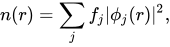
where the coefficients

are the occupation numbers given by the
Fermi–Dirac distribution at the temperature of the system with the restriction

, where

is the total number of electrons. In the equation above,
![{\displaystyle v_{\rm {H}}[n]}](https://wikimedia.org/api/rest_v1/media/math/render/svg/5e971b5be9366636f5d95a9ea4f7440f6b3ef243)
is the Hartree potential and
![{\displaystyle v_{\rm {xc}}[n]}](https://wikimedia.org/api/rest_v1/media/math/render/svg/19b7d72d25c7272ecb1cecaa9fa4894de940b44f)
is the
exchange–correlation potential,
which are expressed in terms of the electronic density. Formally, one
must solve these equations self-consistently, for which the usual
strategy is to pick an initial guess for the density,

, substitute in the Kohn–Sham equation, extract a new density

and iterate the process until
convergence is obtained. When the final self-consistent density

is reached, the energy of the system is expressed as:
![{\displaystyle E[n]=\sum _{j\in {\text{occupied}}}\epsilon _{j}-{\tfrac {1}{2}}\int v_{\rm {H}}[n]n(r)\,\mathrm {d} r-\int v_{\rm {xc}}[n]n(r)\,\mathrm {d} r+E_{\rm {xc}}[n]}](https://wikimedia.org/api/rest_v1/media/math/render/svg/bf117d50022385baf1b8c608cb6034bc1e60e78b) .
.
https://en.wikipedia.org/wiki/Harris_functional

No comments:
Post a Comment